

Acoustic Emission Inspection of Metal Tanks: The NDT Method That Detects Defects in Real Time
What is a temporary business license?
Managing the integrity of industrial assets increasingly requires techniques that can improve safety, reduce operating costs, and minimize service interruptions.
In this context, acoustic emission (AE) inspection has established itself as one of the most effective methods for assessing the condition of metal tanks, pressure vessels, LPG spheres, and industrial storage systems.
During the webinar organized by Apave Spain, Milad Rahmouni, a specialist in nondestructive testing, explained how this technology enables the detection of acoustic activity associated with active defects in real time, providing valuable information on the integrity of facilities without the need for invasive inspections.
|
“Acoustic emission is a technique that sensitively detects defects as they occur, live and in real time.” |
 |
What is acoustic emission?
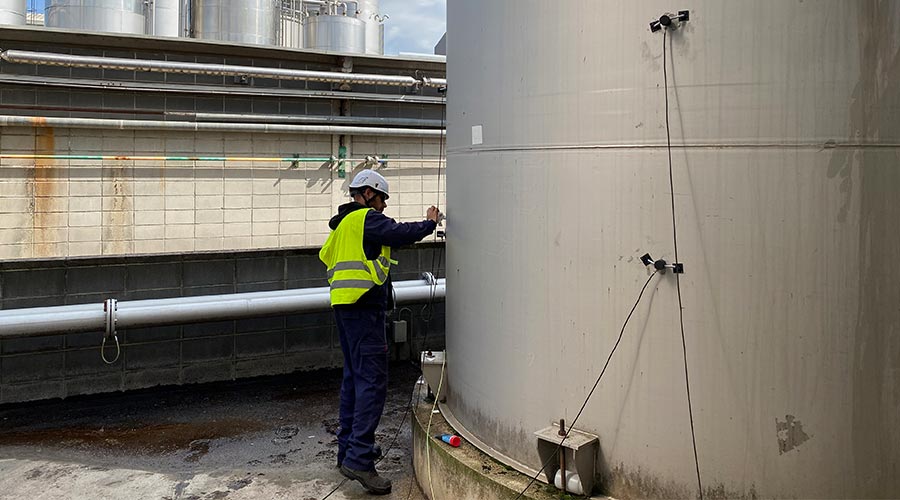
Acoustic emission is a non-destructive testing (NDT) method based on the detection of waves generated by the release of energy that occurs when a material exhibits internal activity associated with developing defects.
Unlike other techniques that evaluate the static state of a structure, acoustic emission makes it possible to identify areas with activity consistent with developing defects, such as:
- Progressing corrosion.
- Crack growth.
- Localized fractures.
- Active porosity.
- Leaks.
- Progressing weld defects.
In simple terms: if something occurs within the material that changes its state (for example, a growing microcrack, corrosion that generates activity, or an incipient leak), that process produces acoustic waves that become a measurable signal.
Its main distinguishing feature is that it allows us to determine whether an asset is undergoing degradation processes during the inspection itself, providing a dynamic view of the risk.
“Defects evolve if they are growing,
moving, or releasing energy under load.”
Regulations and Reference Framework: A Technical Basis for Decision-Making
One of the added benefits of a robust technique is that it does not depend solely on “inspector discretion,” but rather on a technical and procedural framework. In the application of EA, regulations such as the following are cited:
- ASME (an international standard used for acoustic emission, referred to in the document as ASME Sec. V Art. 12).
- UNE/EN standards related to inspection and testing of vessels (references such as UNE 15856 and UNE 14584 for spheres and LPG evaluation are mentioned).
- API / RP / ERP operational and safety standards for integrity in the oil and gas industry (API 580 and 581).
- Royal Decrees and regulations in Spain for tanks (e.g., RD 656/2007 for periodic inspections of APQ tanks).
- Requirements for pressure equipment (ITC-EP3) and gaseous fuels.
How does an acoustic emission inspection work?
The methodology involves installing sensors on the outer surface of the tank or equipment to be inspected.
In the case of vertical storage tanks, sensors are typically placed at two levels:
- A ring near the bottom of the tank.
- A second ring located below the level of the stored product.
When the equipment is under load (whether from the column of product itself, internal pressure, or normal operating conditions), active defects generate acoustic signals that are detected by the sensors. These signals are then:
- Amplified.
- Filtered to eliminate interference.
- Processed using specialized software.
- Analyzed by qualified technicians.
All of this enables real-time monitoring of the asset’s structural behavior.
Under load, the structure may undergo processes such as microcracking, wear, local deformations, or corrosion-related loosening. This activity generates acoustic waves (longitudinal, transverse, or surface waves). The system converts the acoustic signal into an electrical signal, processes it, and displays it as interpretable data.
An efficient alternative to conventional inspections
One of the highlights of the webinar was the comparison between acoustic emission and traditional methods of tank bottom inspection.
In a conventional inspection, it is usually necessary to:
- Drain the tank.
- Clean it.
- De-gas it.
- Partially or completely shut down the plant.
- Allow personnel access to the interior.
“Real-time” as an operational advantage
EA allows you to see if the system is active during the inspection. In addition to one-time sessions, it can be configured for periodic monitoring (months or even a year), depending on the objective.
In many cases, acoustic emission testing allows for evaluation while the asset is in service or with minimal operational disruption, significantly reducing downtime and the risks associated with working in confined spaces.
What information do the results provide?
Data interpretation is a critical phase of the process. During monitoring, the following are recorded:
Events
These are specific indications detected by the system. The presence of events does not necessarily imply the existence of a significant anomaly.
Clusters
Clusters are groups of events concentrated in a specific area of the asset. As explained in the webinar, they become particularly significant when they affect more than 5% of the diameter of the analyzed tank.
In addition, specialists analyze aspects such as:
- Location of the activity.
- Signal intensity.
- Evolution during loading.
- Spatial distribution.
- Correlation with the facility’s operating conditions.
Industrial Applications of Acoustic Emission
-
APQ TanksThey are especially useful in facilities that store flammable, toxic, or corrosive products, where traditional inspections can have a significant operational impact.
-
LPG SpheresThis technique makes it easier to assess structural integrity without resorting to complex access procedures or invasive testing.
-
Pressure EquipmentIt can supplement or, in certain scenarios, serve as an alternative to some hydraulic tests, provided that the design code, applicable regulations, and the corresponding technical evaluation allow for it, thereby helping to optimize inspection processes.
-
Industrial PipingIt allows you to detect activity associated with leaks and monitor hard-to-reach critical lines.
Key Advantages of Acoustic Emission Testing
EA stands out for its direct impact on operations and safety. In particular, this approach avoids procedures that, when performed on tanks, can be time-consuming and costly.
- It detects acoustic activity associated with active defects in real time.
- It reduces plant downtime.
- Avoids intrusive bottom inspections
- Reduces risks to personal safety
- It is an alternative to hydraulic testing in certain cases
- Allows for extended monitoring.
- Optimization of maintenance and inspection programs.
- Comprehensive assessment of large areas using a small number of sensors.
Typical defects that can be detected
EDM focuses on processes involving energy release, such as:
- Progressive corrosion (corrosion “will become visible because it progresses”).
- Surface cracks and fractures.
- Pores and small holes.
- Leaks, which may be indicated by changes in pressure or level.
- Activity at weld joints, if it affects the material and is progressing.
Limitations to Consider
Like any non-destructive testing method, acoustic emission also has limitations. The technique is specifically designed to detect developing defects through their acoustic activity. Therefore, it may not identify:
- Passive defects: lack of penetration or lack of fusion that do not progress may go unnoticed if they show no activity during the test.
- Uniform, stabilized corrosion without associated activity.
- Deformations or quantification of wall thickness losses that have already stabilized.
- Possible interference from the operating environment (agitators, sludge, electromagnetic noise).
The Importance of a Comprehensive Inspection Strategy
Acoustic emission is not intended to replace all non-destructive testing methods, but rather to complement a comprehensive facility integrity strategy.
When properly integrated into inspection programs, it allows for the targeted allocation of resources, the prioritization of actions, and the collection of valuable information on the actual behavior of the facilities, helping to make informed decisions regarding maintenance, repairs, or the extension of inspection intervals.
“No technique is perfect,
which is why it requires interpretation and context.”
FAQs on Noise Emission Inspections for Metal Tanks
-
What is a noise emission inspection?Acoustic emission testing is a non-destructive testing method that detects active defects in metal structures by detecting acoustic waves generated by the release of energy within the material. This technique allows for real-time monitoring of equipment condition without damaging or disassembling it.
-
What is the purpose of acoustic emission in a metal tank?It is used to assess the structural integrity of the tank and detect developing defects, such as active corrosion, cracks, leaks, or weld defects. It also helps identify areas that require a more detailed inspection.
-
How do you inspect a storage tank without emptying it?The most efficient way to inspect a storage tank without emptying it is through non-intrusive techniques such as acoustic emission, when applicable regulations and the inspection strategy permit it. This method takes advantage of the tank’s normal operating conditions and allows for the analysis of its structural behavior using sensors installed on the exterior, thereby avoiding the costs, risks, and time associated with emptying, cleaning, and degassing the equipment.
-
Is it necessary to empty the tank to perform a noise emission inspection?Not in most cases. One of the main advantages of this technique is that it can be performed while the tank is in service or under normal operating conditions, thereby avoiding prolonged downtime for the facility.
-
What defects can acoustic emission detection identify?
This technique is particularly effective for detecting:
- Active corrosion.
- Growing cracks.
- Localized fractures.
- Porosity.
- Leaks.
- Abnormal activity in welds.
-
What defects can acoustic emission testing not detect?
It may not detect:
- Penetration defects, if they show no activity during the test.
- Failure to fuse, if no activity is detected during the test.
- Stabilized uniform corrosion.
- Already stabilized thickness losses.
- Passive defects that do not progress during the inspection.
-
What is the best technique for inspecting the bottoms of APQ tanks?The answer depends on the purpose of the inspection. If the goal is to detect active defects and reduce operational downtime, acoustic emission is one of the most efficient techniques, since it often allows for assessing the tank’s integrity without having to empty it. However, to quantify wall thickness losses or characterize specific defects, it may be necessary to supplement this technique with others, such as ultrasonic testing. The most recommended approach is a combined strategy based on risk and mechanical integrity.
-
Is acoustic emission a non-destructive test?Yes. It is a form of non-destructive testing (NDT) and allows for the inspection of industrial facilities and assets without disrupting their operation or compromising their integrity.
-
What are the advantages of acoustic emission testing over a conventional inspection?
- Reduces downtime.
- Minimizes the impact on production.
- Increases safety.
- Prevents access to the interior of the tank.
- Enables real-time monitoring.
- Can be used on large surfaces.
-
How many sensors are used in an acoustic emission inspection?Two sensor rings are typically used. In vertical tanks, six sensors are usually installed at the bottom and another six at the top, although the number may vary depending on the diameter and geometry of the tank.
-
Can acoustic emission be applied to APQ tanks?Yes. This technique is particularly well-suited for APQ tanks that store flammable, toxic, or corrosive products, as it helps reduce the operational impact of regulatory inspections.
-
Can it be applied to horizontal or sand-covered tanks?If the tank is covered with sand and there is no access to the surface, this technique cannot be performed. In horizontal tanks, a “linear” system could be considered, but access and mobility are required.
-
How do you assess the structural integrity of an industrial tank?The structural integrity of an industrial tank must be assessed through an inspection program that combines document review, visual inspections, and appropriate nondestructive testing. Acoustic emission testing helps identify developing defects and locate critical areas, while other complementary techniques can confirm the nature and extent of the detected damage. This combination provides a more comprehensive view of the asset’s actual condition.
-
What does it mean for a defect to be active?An active defect is one that is evolving during operation or while a load is being applied to the equipment. As it grows or propagates, it releases energy that can be detected by acoustic emission sensors.
-
Does the acoustic emission allow a defect to be pinpointed exactly?Not exactly. It allows for the precise identification of the area where the activity is taking place, making it easier to conduct more targeted follow-up inspections.
-
Can it be used in pressurized containers and LPG spheres?Yes. It is a technique widely used for pressure vessels, LPG storage tanks, and other industrial assets where it is essential to assess structural integrity with as little operational impact as possible.
-
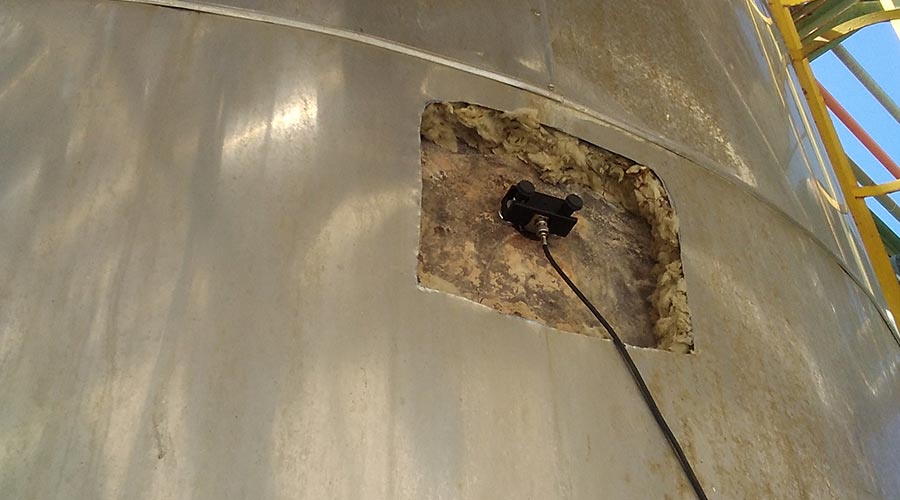
Can the EA technique be used on thermally insulated tanks?Yes, you can drill holes to install sensors without any problem.
-
Can noise emissions help extend inspection intervals?Depending on applicable regulations, operating conditions, and the results obtained, the information provided by acoustic emission can help optimize risk-based inspection and maintenance strategies.
Conclusions
Acoustic emission inspection is an advanced tool for managing industrial safety and integrity. Its ability to detect acoustic activity associated with active defects in real time, minimize operational disruptions, and improve decision-making makes it a particularly valuable solution for metal tanks, pressure vessels, and other critical infrastructure.
At Apave Spain, we help organizations implement innovative inspection techniques that improve the reliability of their facilities, optimize their maintenance programs, and contribute to a safer, more efficient, and more sustainable industry.
Learn more about our acoustic emission services
Our Other News